

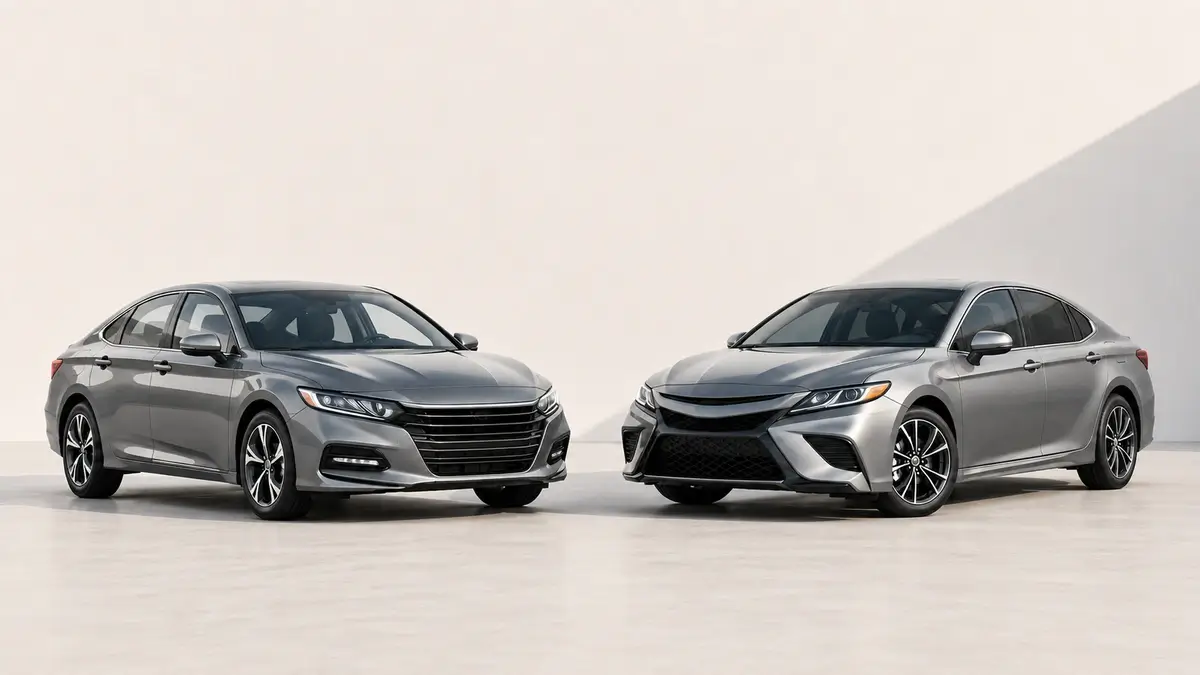
For most used buyers, the cleanest answer is simple: the Camry is the safer default, and the Accord is the better conditional buy when price, trim, mileage, and condition shift the value argument in its favor. That is the split most generic comparison pages blur. They compare nameplates. A used-car buyer has to compare examples.
Here is the fast version:
- Choose the Camry if you want the easier ownership case and the least stressful recommendation.
- Choose the Accord if you want the more satisfying daily drive and the specific car is clearly the better same-budget deal.
- Skip the higher trim on either one if it mostly adds image, wheels, or a premium that does not improve daily use.
- Treat a hybrid as a math decision, not a badge decision.
- Walk away from either sedan if the service history is weak and the seller still wants strong money.
The most common mistake in a honda accord vs toyota camry decision is not choosing the wrong brand. It is choosing by reputation before checking condition, trim, and price.
CarMerit reliability comparator
Honda Accord vs Toyota Camry: 2004-2026 NHTSA snapshot
Owner-complaint and recall counts from NHTSA for 2004-2026, plus the best used-year lanes and buyer-fit logic for each sedan.
| 14,355 | complaints (2004-26) | 12,881 |
| 188 | recalls (2004-26) | 99 |
Airbags / seatbeltsElectricalBrakesEngine | top issues | Airbags / seatbeltsVehicle speed controlBrakesEngine |
Honda Accord
Best used lanes: 2015-2017, 2011-2012, 2006-2007
Caution lanes: 2003-2005, 2008-2010, 2013-2014, and some 2018-2019 examples that need stricter proof.
Best for: Buyers who want a stronger same-budget deal or a more rewarding daily drive, but are willing to check records, powertrain behavior, electronics, and trim-specific risk carefully.
Toyota Camry
Best used lanes: 2015-2017, 2013-2014, 2019-2021
Caution lanes: 2007-2009 first; 2004-2006 only as condition-first budget plays.
Best for: Buyers who want the safer-default midsize sedan, lower second-guessing, and the easier ownership case when the exact car is clean and fairly priced.
Quick take: Start with the Camry if you want the safer default and the easiest used-sedan ownership case. Move to the Accord when the specific car is cleaner, better priced, better documented, or more appealing to drive. Do not crown either car from raw NHTSA counts alone.
Complaint counts are raw owner reports filed with NHTSA, not adjusted for sales volume, so they should guide inspection rather than crown a winner. The quick comparator above uses a 2004-2026 shopping-window snapshot; older records have had more time to collect reports, so use the figures as inspection signals, not rankings. Always inspect the specific vehicle before buying.
Honda Accord vs Toyota Camry: Which Used Sedan Makes More Sense?
If you want the shortest honest answer, start with the Camry and move to the Accord only when the specific car gives you a better value or fit case. The Camry wins the easier recommendation. It is usually the sedan you can defend fastest when your goal is lower ownership stress and fewer reasons to second-guess yourself six months later.
The Accord wins the stronger conditional case. If the price gap is fair, the trim makes more sense, or the condition is cleaner, it often feels like the more rewarding car to live with without becoming a reckless choice. That distinction matters because the better car and the better deal are not always the same thing.
Most buyers do not need a magazine-style “winner.” They need to know where the safer default sits and what exact conditions should make them change their mind.
The table below gives that answer first, before the details start pulling the decision apart.
| Factor | Honda Accord | Toyota Camry |
|---|---|---|
| Safer default | Good, but more conditional | Stronger |
| Better driving feel | Usually stronger | Usually calmer |
| Better same-budget value | Stronger when the specific Accord is cleaner or materially cheaper | Stronger when the Camry’s condition and records justify the price gap |
| Better low-drama ownership case | Good | Better |
| Better for cautious buyers | Fair | Strong |
| Better for buyers who want more personality | Strong | Fair |
If both cars are clean, fairly priced, and broadly similar, the Camry is the safer pick. If the Accord is cleaner, better equipped, or clearly cheaper at the same budget, it becomes the smarter buy faster than many buyers expect.
Accord and Camry are two of the strongest used sedans under $20,000, but the better buy depends on year, records, and price. For a broader budget comparison, see our best used cars under $20,000 guide.
Scope, Assumptions, and How This Comparison Is Framed
This comparison is built for U.S. used-car shoppers, not new-car showroom cross-shopping.
The cleanest way to compare these two sedans is same-budget against same-budget. That means similar age, similar mileage, similar condition, and similar trim ambition. If one car is much newer, much cleaner, or much better documented, the answer can change quickly.
That is normal. It is also why broad reputation alone is not enough.
A few rules keep the comparison honest:
- clean history matters more than image
- mainstream trims matter more than edge-case configurations
- ownership horizon matters more than brochure appeal
- a nicer-looking car is not automatically the smarter used buy
- price only matters after condition is accounted for
A quick example shows the point. A clean mid-trim Accord can be a smarter buy than a higher-mileage Camry leaning too hard on Toyota’s reputation. The reverse is also true if the Camry is cleaner, better documented, and only modestly more expensive.
IIHS Safety: The Exact Year Matters
The Camry being the “safer default” in this comparison is an ownership-decision label, not a blanket crash-safety verdict. IIHS results change by generation, test type, and sometimes build date, so the exact used example still matters.
| IIHS comparison point | Honda Accord | Toyota Camry |
|---|---|---|
| Small overlap front | 2018–22: G on both driver- and passenger-side tests; 2023–26: G | 2018–24: G on both driver- and passenger-side tests; 2025–26: G on the hybrid-only IIHS scope |
| Updated side test | 2018–22: M | 2018–23 models built before February 2023: P |
| Updated side test — later cars | 2023–26: G | 2023–24 models built after January 2023: G; 2025–26: G on the hybrid-only IIHS scope |
| Updated moderate overlap front | 2023–26: G | 2023–24: M; 2025–26: G on the hybrid-only IIHS scope |
Table Note: IIHS uses G = Good, A = Acceptable, M = Marginal, and P = Poor. These are selected buyer-relevant change points, not complete IIHS histories or combined safety scores. IIHS test procedures and criteria evolve, so compare the same test family and preserve exact model-year, configuration, and build-date applicability. The 2025–26 Camry IIHS scope is hybrid-only.
The useful takeaway is not that one badge is automatically safer. The bigger point is that newer test results and exact applicability can materially change the safety picture. The Camry has an especially important 2023 build-date split in the updated side test, while the 2023-and-newer Accord shows Good ratings in the updated side and updated moderate-overlap tests shown above.
Space, Comfort, and Everyday Practicality
The Accord usually makes the stronger case for buyers who care about rear-seat room, trunk usefulness, and a cabin that feels a bit more polished day to day.
That matters if adults regularly sit in the back, if the car handles family duty, or if long drives happen often enough for seat comfort and cabin layout to become real ownership issues instead of test-drive impressions.
The Camry’s practical edge is different. It tends to feel easier to live with. The whole experience is often calmer and simpler, which matters if the car is mostly a commuter tool and you want it to disappear into your routine.
The wrong move here is letting appearance packages distort the decision. A sportier trim can look better online while quietly giving you less comfort, more wheel-and-tire cost, and no real daily benefit.
If your sedan will regularly carry adults, luggage, work gear, or family traffic, the Accord deserves the harder look. If it is mostly solo commuting and easy daily miles, the Camry’s simpler personality matters more than a slightly nicer cabin impression.
| Practicality check | Honda Accord | Toyota Camry |
|---|---|---|
| Rear-seat comfort | Usually stronger | Usually good |
| Trunk usefulness | Usually stronger | Usually good |
| Easy commuter feel | Good | Usually better |
| Best fit for frequent passenger use | Stronger | Fair to good |
| Best fit for low-stress daily use | Good | Stronger |
Driving Feel, Powertrains, and Fuel-Economy Trade-Offs
The Accord still makes the stronger case for buyers who care about steering feel and a more responsive daily drive. The Camry is generally the calmer commuter. Fuel economy, however, should be compared by exact year, powertrain, drivetrain, and trim rather than by badge.
Selected EPA ratings show why. Common four-cylinder versions are often close, while performance powertrains, hybrid trims, and AWD can create much larger differences.
Honda Accord EPA Fuel Economy
| Model Year | Configuration | City | Highway | Combined |
|---|---|---|---|---|
| 2018–20 | Accord 1.5L CVT FWD | 30 | 38 | 33 |
| 2018–22 | Accord 2.0T Sport/Touring FWD | 22 | 32 | 26 |
| 2018 | Accord Hybrid FWD | 47 | 47 | 47 |
| 2019 | Accord Hybrid FWD | 48 | 48 | 48 |
| 2020 | Accord Hybrid FWD | 48 | 47 | 48 |
| 2021–22 | Accord 1.5L CVT FWD | 30 | 38 | 33 |
| 2021–22 | Accord Sport/Touring 1.5L FWD | 29 | 35 | 32 |
| 2021 | Accord Hybrid FWD | 48 | 48 | 48 |
| 2022 | Accord Hybrid FWD | 48 | 47 | 47 |
| 2021–22 | Accord Hybrid Sport/Touring FWD | 44 | 41 | 43 |
| 2023–26 | Accord 1.5L CVT FWD | 29 | 37 | 32 |
| 2026 | Accord SE 1.5L CVT FWD | 28 | 36 | 31 |
| 2023–26 | Accord Hybrid FWD | 51 | 44 | 48 |
| 2023–26 | Accord Hybrid Sport/Touring FWD | 46 | 41 | 44 |
Table Note: EPA MPG is shown as city/highway/combined. These are selected configurations that materially change the used-buying comparison, not every available Accord configuration. EPA estimates are standardized for comparison; actual fuel economy varies with driving, weather, load, condition, and other factors.
Toyota Camry EPA Fuel Economy
| Model Year | Configuration | City | Highway | Combined |
|---|---|---|---|---|
| 2018–24 | Camry LE/SE 2.5L FWD | 28 | 39 | 32 |
| 2020–24 | Camry XLE/XSE 2.5L FWD | 27 | 38 | 31 |
| 2020–24 | Camry AWD LE/SE 2.5L | 25 | 34 | 29 |
| 2020–24 | Camry AWD XLE/XSE 2.5L | 25 | 34 | 28 |
| 2018–24 | Camry Hybrid LE FWD | 51 | 53 | 52 |
| 2018–24 | Other listed Camry Hybrid FWD trims | 44 | 47 | 46 |
| 2018–24 | Camry XSE V6 FWD | 22 | 32 | 26 |
| 2020–24 | Camry TRD V6 FWD | 22 | 31 | 25 |
| 2025 | Camry Hybrid LE FWD | 53 | 50 | 51 |
| 2025 | Camry Hybrid SE/XLE/XSE FWD | 48 | 47 | 47 |
| 2026 | Camry Hybrid LE FWD | 52 | 49 | 51 |
| 2026 | Camry Hybrid SE/XLE/XSE FWD | 47 | 45 | 46 |
Table Note: EPA MPG is shown as city/highway/combined. The “other listed Camry Hybrid FWD trims” row covers Hybrid XLE/SE for 2018–20 and Hybrid SE/XLE/XSE for 2021–24. The official EPA records used here show the 2025–26 Camry as hybrid-only, with additional AWD hybrid configurations also available. These are selected buyer-relevant configurations rather than a full EPA database dump. Actual fuel economy varies.
The practical result is more nuanced than a blanket Camry fuel-economy win. Common gas four-cylinder versions are close enough that the exact configuration matters more than the badge. The Camry Hybrid LE has a clear efficiency advantage over the Accord hybrids shown here, but higher-trim Camry hybrids give back part of that advantage. Performance-oriented Accord 2.0T and Camry V6/TRD configurations also carry a meaningful fuel-economy penalty.
Hybrid logic should therefore stay simple: buy the hybrid when your driving pattern and purchase price make the efficiency advantage worthwhile. Do not pay more for a hybrid—or a sportier powertrain—without checking whether the exact configuration improves the ownership math you actually care about.
Reliability, Maintenance Burden, and Ownership Cost
This is where the Camry earns its safer-default label.
The Camry’s reputation matters because it lowers how much explaining you need to do to yourself after buying. That matters for cautious buyers, family buyers, and anyone who values predictability more than character.
The Accord is not a risky choice by default. The problem is that buyers are more likely to rationalize it because it often feels better to drive and often looks like the more rewarding choice. That makes it easier to overlook weak history, inflated pricing, or the wrong trim.
Maintenance burden depends more on the exact car than buyers sometimes want to admit. Large wheels, neglected service, premium-trim wear, and high-mileage examples can change the ownership math quickly on both sedans.
Check Special Coverage Before Assuming a Repair Is Out of Pocket
For some recent used examples, manufacturer special coverage can materially change the ownership math. That makes VIN verification worth doing before assuming a known repair will automatically be your expense.
If the Accord and Camry you are comparing fall into these coverage years, check both model years in CarMerit’s Manufacturer Special Coverage Lookup before letting an A/C or coolant-related repair tilt the deal toward one sedan; the exact VIN and manufacturer terms still decide whether coverage applies.
| Vehicle | Applicable Years | Buyer-Relevant Coverage | What to Verify |
|---|---|---|---|
| Honda Accord | 2018–20 | Honda extended coverage for certain A/C condenser manufacturing or corrosion leaks to 10 years from the original purchase date with unlimited miles | VIN eligibility, diagnosis, title/vehicle status, and whether the leak falls within the covered condition |
| Honda Accord Hybrid | 2018–21 | Honda extended coverage for certain A/C condenser manufacturing or corrosion leaks to 10 years from the original purchase date with unlimited miles | VIN eligibility, diagnosis, title/vehicle status, and whether the leak falls within the covered condition |
| Toyota Camry / Camry Hybrid | Certain 2018–21 vehicles | Toyota Customer Support Program 24TE04 addresses eligible flow shut-off valve coolant-leak repairs | Exact VIN eligibility and Toyota’s current program terms before assuming coverage remains available |
This is not evidence that either problem will happen to a car you buy. It is a reason to check the VIN and coverage status before agreeing on price or paying for a repair that may qualify.
Table Note: These are selected buyer-material special-coverage examples, not complete warranty-extension histories. Honda’s condenser extensions apply only to the covered manufacturing/corrosion leak condition; unrelated damage such as foreign-object damage is excluded. For the Camry program, the retained official evidence does not support publishing an exact extended time or mileage limit, so verify the current Toyota terms and vehicle eligibility directly.
The right discipline is simple:
- buy the cleaner history, not the louder reputation
- treat overdue maintenance as part of the purchase price
- penalize flashy trims if tires, brakes, or suspension wear are coming soon
- do not assume a nicer interior means the better ownership story
| Ownership check | Honda Accord | Toyota Camry |
|---|---|---|
| Best ownership path | Clean mainstream trim with fair price | Clean mainstream trim with fair price |
| Risk rises when | Better drive hides weak upkeep | Badge comfort hides weak value |
| Smart buyer move | Verify condition before chasing feel | Verify value before paying more for the specific Camry |
| Safer default result | Good | Better |
If your priority is reducing the chance of regret, the Camry remains the easier recommendation. If the Accord is well-kept, fairly priced, and does not ask you to ignore obvious upcoming cost, it can still be the smarter buy.
NHTSA Evidence Snapshot: Accord vs Camry
| Vehicle | Available NHTSA years | Owner complaints | Unique recall campaigns / manufacturer communications | Buyer-useful read |
|---|---|---|---|---|
| Honda Accord | 1979; 1981–2026 | 23,090 | 103 / 5,086 | The higher raw record volume makes exact-year inspection, service-history checks, and VIN verification important; it does not establish a higher defect rate or lower reliability. |
| Toyota Camry | 1983–2026 | 17,289 | 72 / 7,845 | The lower raw record volume does not prove better reliability because the counts are not adjusted for vehicle population or time on the road. Use the records to guide exact-year and VIN checks, not to crown a winner. |
Table note: Use this as broad NHTSA record context, not a reliability ranking. Complaint totals are raw owner reports and are not sales-adjusted. Recall campaigns and manufacturer communications show where buyers should verify records, VIN status, and inspection priorities before purchase.
Best Years to Target and Risky Years to Be Careful With
This page is still a comparison page, not the final year-by-year audit for each sedan. So the useful move here is not fake precision. It is a real risk filter that helps you shop smarter right away.
For this comparison, the safer starting point is later, well-documented examples in your target shopping range, not the cheapest early-transition car you can find.
That applies to both cars, but the way buyers get trapped is a little different.
On the Accord side, risk rises fastest when shoppers get pulled toward nicer equipment and forget to price in maintenance, wear items, or whether the “deal” only exists because the car needs work.
On the Camry side, risk rises fastest when shoppers pay more for a specific car without making the seller prove the condition, history, and trim value.
If your shortlist now has one Accord and one Camry, first confirm that both listings accurately identify the cars you are comparing. Run each VIN through CarMerit and cross-check the returned vehicle details against the seller’s description and paperwork. Then compare the Accord’s maintenance and equipment trade-offs against the Camry’s price and condition, rather than letting an incorrect trim or configuration distort the matchup.
Use this year-and-risk filter first:
| Shopping pattern | Honda Accord | Toyota Camry |
|---|---|---|
| Best starting point | Later, clean examples with mainstream trims and strong records | Later, clean examples with mainstream trims and strong records |
| Use more caution with | Cheap loaded cars, patchy records, obvious deferred maintenance | Overpriced “safe” cars, patchy records, appearance-heavy trims |
| Common buyer mistake | Paying for the nicer feel while ignoring upkeep | Paying for the badge while ignoring value |
| Smarter move | Favor documentation over trim ambition | Favor fair pricing over reputation comfort |
A good shortcut is this: later and cleaner usually beats older and flashier. A bargain upper-trim car with weak records is rarely the value win it first appears to be.
If your final choice comes down to exact year bands, stop here and use year-specific Accord and Camry guides before buying. The comparison page should narrow the direction. The year page should settle the final filter.
Trim Sweet Spots and Overpay Traps
On both sedans, the best-value trim usually sits in the middle of the range, not at the top.
The Accord usually makes the most sense in a trim that gives you real comfort and daily-use tech without pushing you into purely cosmetic extras or replacement-cost headaches. The Camry usually makes the most sense when you protect its easy-ownership advantage instead of turning it into a premium-priced appearance package.
Pay more only if the upgrade changes daily life in a real way.
That usually means:
- better seat comfort
- a safety feature you actually care about
- daily-use tech you will notice
- a setup that makes the car easier to live with every week
That usually does not mean:
- bigger wheels
- darker trim
- image-only upgrades
- paying extra just because it is the top trim
| Trim decision | Honda Accord | Toyota Camry |
|---|---|---|
| Best-value direction | Mid trim with real comfort/tech gains | Lower-to-mid trim with strong ownership logic |
| Easy overpay trap | Chasing the nicest-looking upper trim | Paying extra for reputation plus appearance |
| Pay more only if | Daily use improves clearly | Daily use improves clearly |
| Usually safest used move | Cleaner mid trim | Cleaner lower or mid trim |
The wrong trim can erase the advantage of either sedan surprisingly fast. That is why trim value matters more here than most broad comparison pages admit.
Used Pricing, Resale, and Overall Value
This is where the answer can flip because the better car and the better deal are not always the same thing.
Value has to be judged from the specific listings in front of you, not from a fixed assumption that one badge always costs more or automatically holds value better.
If the Camry is cleaner, better documented, or otherwise the stronger example, paying more can make sense. If the Accord is equally clean or better equipped for less money, it can become the stronger same-budget choice.
The point is not to assume a Toyota premium or an Accord discount. Ask whether the exact car earns its asking price after condition, mileage, trim, records, and upcoming wear are accounted for.
Prices vary by year, mileage, trim, condition, and location. Verify local listings before buying.
That line matters because it protects you from the most common used-car mistake in this comparison: paying for brand comfort instead of real value.
Use this value rule:
- compare examples first
- compare condition before trim
- compare ownership stress, not just asking price
- do not pay a premium unless the car clearly earns it
Choose the Accord If… Choose the Camry If…
Choose the Accord if:
- you care about driving feel and cabin polish
- you want stronger same-budget value
- you regularly use the rear seat or trunk
- the specific car is cleaner or better equipped for similar money
Skip the Accord if:
- you mainly want the least stressful answer
- the price is too close to a cleaner Camry
- you are talking yourself into it despite weak history or obvious upkeep risk
Choose the Camry if:
- you want the safer default
- you care more about low-drama ownership than personality
- the specific example is fairly priced and well documented
- easy commuting matters more than driver feel
Skip the Camry if:
- you are paying more for reputation without a clear condition, documentation, or fit advantage
- the trim is flashy but the history is weak
- the Accord next to it is cleaner, better equipped, or better priced
If you are still building a broader sedan shortlist, start with our best used midsize sedans guide. It explains why Accord and Camry should usually be compared first, and when other midsize sedans deserve a look.
If you are choosing between the Accord and Camry for family use, also compare them against family SUVs. Our best used family cars guide explains when a sedan is smarter than a CR-V, RAV4, CX-5, Corolla Cross, or HR-V.
Final Verdict
For most used buyers, the cleanest answer is still the same: start with the Camry as the safer default, then switch to the Accord only when the specific car makes the better same-budget case.
Buy the Camry when you want the easier ownership argument and the price still makes sense. Buy the Accord when the specific car gives you better value, better fit, or more daily satisfaction without asking you to ignore condition or upcoming cost.
The wrong move is not choosing either sedan. The wrong move is choosing by badge reputation alone.
If the Camry stays on your shortlist but you want a more value-focused or driver-focused alternative, Mazda belongs in the conversation too. Our Mazda6 vs Toyota Camry comparison explains when the Camry’s safer ownership case beats the Mazda6 and when the Mazda becomes the sharper used buy.
If both the Accord and Camry feel too expensive or too common, the Mazda6 is the main used-sedan alternative worth checking. Start with the Mazda6 years to avoid and best years to buy guide so the lower price does not pull you into an older recall-sensitive car or a rough early third-generation example.
Accord vs Camry is one of the strongest reliability-focused sedan matchups. If you are still deciding whether a sedan or SUV makes more sense, use our Most Reliable Used Cars guide next.
Frequently Asked Questions
Is the Honda Accord or Toyota Camry the safer used buy?
The Camry is usually the safer default. It is easier to recommend when your priority is lower ownership stress and fewer surprises. The Accord can still be the smarter buy, but it asks for more discipline on price, trim, and condition.
Which one is cheaper to fuel and maintain over time?
Fuel cost depends heavily on the exact powertrain and trim. Common four-cylinder Accord and Camry configurations are close in the EPA ratings above, while the Camry Hybrid LE makes a stronger efficiency case and higher-performance or higher-trim configurations can give back part of that advantage.
Maintenance is harder to crown by badge. The official evidence here does not establish a model-wide maintenance-cost winner, so service history, condition, wear items, and any applicable special coverage matter more than a blanket Honda-versus-Toyota claim.
Which one has more front and rear passenger space?
The Accord often feels like the roomier and more accommodating sedan for passengers and cargo. The Camry is still practical, but the Accord usually makes the stronger case if adults sit in the rear often or you care more about cabin usefulness.
Is the Toyota Camry worth paying more for in the used market?
Sometimes. If the premium is modest and the Camry is clearly cleaner, better documented, or a better fit for your risk tolerance, it can still be worth it. If the gap is wide and the Accord is comparable or better equipped, Toyota’s reputation alone is not enough.
Are the hybrid versions worth buying used?
They can be, especially for higher-mileage drivers. The key is not just buying a hybrid, but buying the right hybrid example at the right price with the right history. A big used premium can erase the benefit quickly.
Which trim gives the best value for most buyers?
Usually a mid-pack trim that adds real comfort, safety, or daily-use tech without dragging you into appearance-heavy upgrades. On both sedans, the flashiest trim is often not the smartest used buy.
Which one is better for highway commuting, family duty, and winter driving?
For highway commuting, the exact powertrain matters more than the badge. Common four-cylinder Accord and Camry configurations are close on EPA fuel economy, while hybrid, AWD, and performance-oriented versions can change the numbers much more.
For family duty, the Accord makes the stronger case when rear-seat room and trunk usefulness matter more. For winter driving, the Camry offered EPA-listed AWD gas configurations for 2020–24, while the Accord configurations compared here are FWD.
AWD can improve available traction, but it does not replace appropriate tires, a clean vehicle history, or a proper pre-purchase inspection.